Laser hair removal is one of the most requested treatments at our Kalyani Nagar clinic, and also one of the most misunderstood. Most of the horror stories patients bring us, burns, dark patches, or hair that came straight back, have the same root: a laser or a setting that was wrong for Indian skin. Here is what actually matters.
Why Indian skin needs a different approach
A hair-removal laser works because the pigment in the hair absorbs the light and heats the follicle. The difficulty is that skin contains the same pigment, melanin. Most Indian skin falls into Fitzpatrick types IV and V, which means more melanin at the surface competing for the laser's energy.
On fair skin with dark hair, almost any laser works. On darker skin, the wrong wavelength or too much energy heats the skin as well as the hair, and that is where burns and post-inflammatory pigmentation come from.
Which lasers are suitable
Two things make a laser safer for darker skin:
- A longer wavelength. 1064 nm (Nd:YAG) passes through the surface with less absorption by skin melanin than shorter wavelengths, and 810 nm diode is the long-standing workhorse for most Indian skin.
- Good skin cooling. A chilled contact tip protects the surface while the follicle underneath is heated.
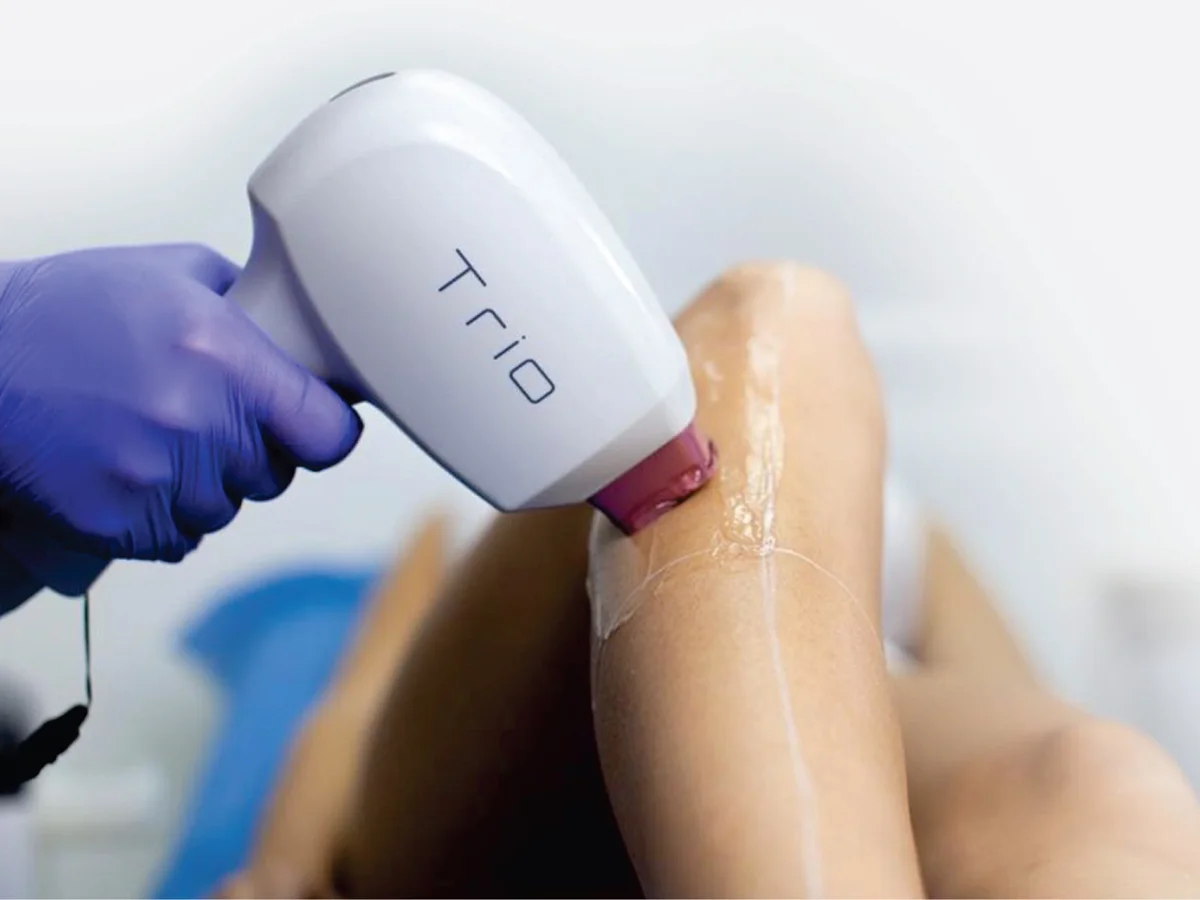
At Skin Essence we use the Coolite BOLT, a diode platform that fires 755, 810 and 1064 nm together under a sapphire-cooled tip, so follicles at different depths are treated in one pass. The machine is only half the story, though. The settings are chosen by a dermatologist for your skin tone, hair thickness and the area, not read off a fixed chart.
What a course really looks like
Hair grows in cycles, and the laser only disables follicles that are in their growth phase. That is why one session is never enough.
- Six to eight sessions for most areas.
- Four to six weeks apart on the face and six to eight weeks on the body.
- A visible reduction after about three sessions, with treated hair shedding one to three weeks after each visit.
Coarse, dark hair responds fastest. Fine hair, and hormonal areas such as the chin in women with PCOS, need more sessions and an occasional touch-up.
Reduction, not removal
Be wary of anyone who promises that every hair will be gone for good. What a full course realistically delivers is a substantial, long-term reduction: far less hair, and what regrows is finer and lighter. If hair growth is hormonally driven, treating the hormones alongside makes the laser result last. Read more on our unwanted hair page.
How to prepare
- Shave the area the day before. Do not wax, thread or pluck for four weeks; the laser needs the root in place.
- Avoid tanning for two weeks before and after. Tanned skin is treated only once the tan fades.
- Pause retinoids and scrubs on the area for a few days.
- Tell us about any medicines, recent sun exposure or a history of pigmentation after injuries.
It is for men too
Beard shaping for a clean cheek and neck line, eyebrow shaping, ears, chest and shoulders are the areas men ask for most. Male hair is coarser, which responds well, but may need a session or two more.
Five questions to ask any clinic
- Which laser do you use, and is it suited to my skin type?
- Who chooses the settings, a doctor or a technician?
- Will you do a test patch if my skin is sensitive or tanned?
- How many sessions do you realistically expect for my hair type?
- What happens if I get redness or darkening afterwards?
If the answers are vague, keep looking.
You can read how we do it on our laser hair reduction page, or visit us in Kalyani Nagar for an assessment and a test patch.